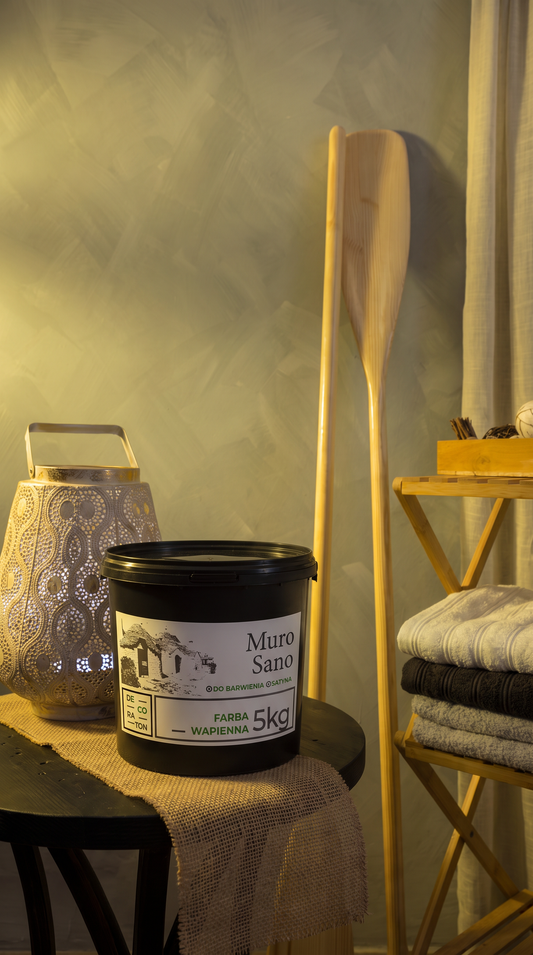
Lime paint (limewash): a natural finish that breathes
Lime paint, often called limewash, is a mineral paint in which the binder is lime. After application, the lime reacts with carbon dioxide in the air and over several days to a couple of weeks hardens into a thin layer of stone. It does not form a plastic film, so the wall stays vapour-permeable, and the high pH of lime inhibits mould growth. The result is a deep matt finish with natural tonal variation that changes with the light. We cover the pros, cons and a comparison with latex paint in our guide lime paint (limewash): what it is.
Muro Sano or Nebbia?
- Muro Sano — an opaque lime paint (min. 35% lime, based on fine lime aggregate and marble), white or for tinting, with a satin or grained texture. For interiors and exteriors, dry and damp rooms. It also works well on damp walls, in basements and in the renovation of old buildings.
- Nebbia — a semi-transparent lime glaze that you tint yourself with inorganic pigments. It builds depth in layers and gives a Mediterranean washed effect; you control the colour intensity with the amount of pigment.
If you simply want a healthy, matt wall, choose Muro Sano. If you are after a washed effect and depth of colour, choose Nebbia. You will find colour inspiration on the lime colours page.
Where does lime paint work best?
- Bedrooms, living rooms and children's rooms — low volatile organic compound content and a simple mineral composition.
- Wabi-sabi, japandi, loft, Scandi and boho interiors.
- Bathrooms, kitchens, laundry rooms and basements — the coating lets water vapour through. Do not use it in areas directly exposed to running water, e.g. in a shower cubicle.
- Old houses, damp walls and walls after flooding — lime does not trap moisture in the wall. Remember that paint does not remove the cause of dampness — more in the article mould on the wall.
What surfaces can it be used on?
Ideally on absorbent mineral surfaces: lime and cement-lime plasters, concrete, primed plasterboard. Non-absorbent surfaces or walls previously painted with latex paint need proper preparation — please consult us before buying.
How much lime paint do I need?
As a guide, 1 kg covers 4–5 m² in one coat on a smooth surface, and 1.5–2 m² on coarse-grained plaster. Two coats are usually applied. Example: a smooth 20 m² wall in two coats needs about 8–10 kg. Actual consumption depends on the absorbency of the surface and the technique — for larger areas, give us a call and we will calculate it together.
How to paint with lime paint?
- Wet the wall generously with water — on most mineral surfaces clean tap water is enough.
- Do not use primers without consulting us — they can seal the surface and prevent the lime from binding.
- Mix the paint vigorously. If you prefer a thinner consistency, dilute it with water.
- Apply with a block brush (lively, chromatic effect) or a roller, usually in two coats. Apply the next coat after 4–6 hours.
- Full curing takes several days to a couple of weeks — during this time the colour continues to lighten.
Full instructions with a list of tools and the most common mistakes: how to paint with lime paint step by step. You can see how lime works on the wall on the art of application page.
Frequently asked questions
How is lime paint different from latex paint?
Lime paint is mineral and vapour-permeable — instead of forming a sealed coating, it bonds with the surface. It gives a soft matt effect with tonal variation that you cannot achieve with latex paint. Latex, on the other hand, is more resistant to scrubbing.
Is lime paint suitable for bathrooms?
Yes, for damp rooms — it lets water vapour through. It is not used in areas directly exposed to running water.
How long does lime paint take to dry?
The surface dries in a few hours, and the next coat is usually applied after 4–6 hours. Full carbonation of the lime takes several days to a couple of weeks.
Is lime paint safe in a bedroom or a child's room?
Yes. It is based on natural lime, has a low volatile organic compound content and is suitable for living spaces. When painting, wear gloves and goggles — wet lime is caustic.
When will I receive my order?
We prepare each batch after the order is placed, so shipping takes up to 14 working days.
Have a question? Call us: +48 605 642 777 — advice is free.


 Made to order