Decorative lime plaster: concrete, travertine, stucco and tadelakt effects
Decoraton Colour decorative plasters are made from lime and crushed marble. They give a wall the texture of concrete, the pattern of travertine or a smooth, polished surface — with no plastics. As lime-based materials, they remain diffusion-open: the wall lets water vapour through and is not sealed under an airtight coating.
Which decorative plaster should I choose?
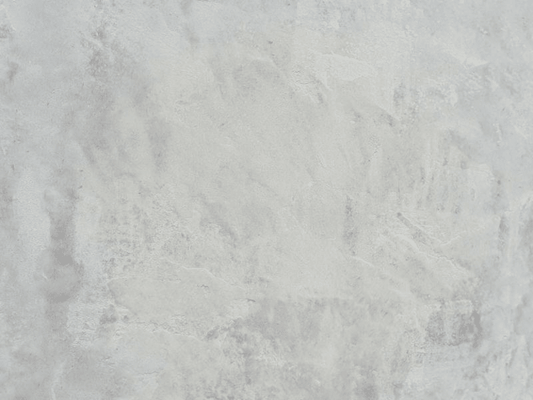
- Concrete effect on the wall: Rebus Parvus (grain up to 0.6 mm — a calmer, more uniform surface, concrete as a backdrop) and Rebus Grassus (up to 2.0 mm — a distinct, raw texture for large surfaces and feature walls). Both contain min. 35% lime.
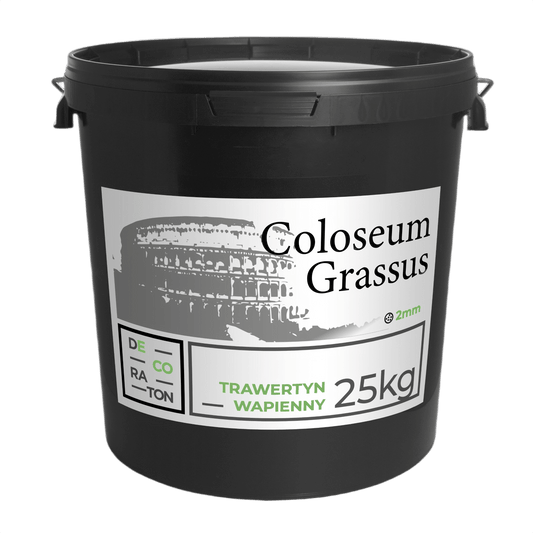
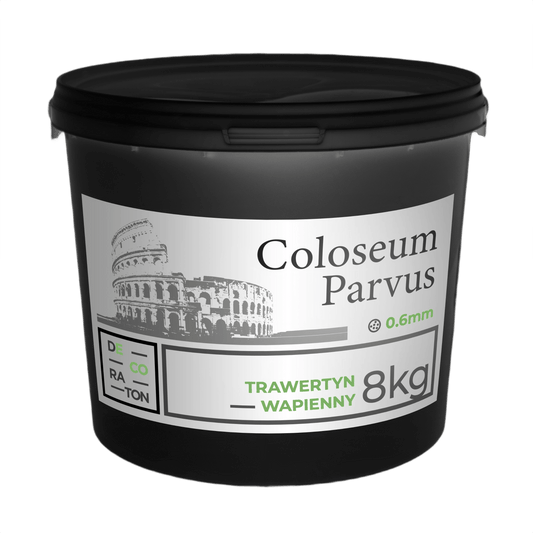
- Travertine on the wall: Coloseum Parvus (0.6 mm — a subtle stone pattern, visible up close) and Coloseum Grassus (2.0 mm — a distinct travertine and sandstone pattern, visible from a distance). Made from naturally coloured crushed marble; the plaster can be drawn with a trowel or shaped by hand.
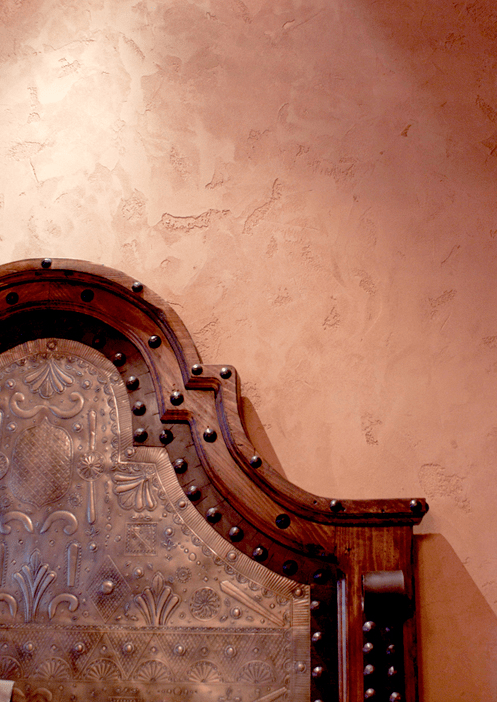
- Lime stucco: Tectorio Elegantere — lime and snow-white marble. Applied thinly and polished to a sheen, it gives the effect of polished marble. For living rooms and representative interiors.
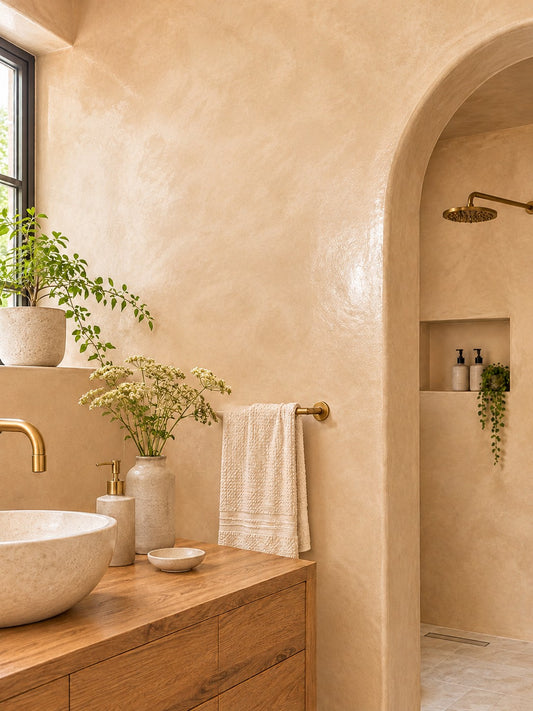
- A bathroom without tiles: Tadelakt — a Moroccan finishing technique using lime plaster. It does not let water through, but it does let water vapour through. For bathrooms and showers.
- A smooth wall in colour: Cinque Terre (finishing plaster up to 0.2 mm — a silky skim coat for tinting with pigments) and Napoli (compound up to 0.04 mm — the finest in our range, builds depth in thin layers, with no visible grain).
Where can decorative plasters be used?
Rebus and Coloseum are suitable for interiors and exteriors, dry and damp rooms. Rebus Parvus works well in living rooms, stairwells, kitchens, bathrooms and — thanks to full diffusion openness — in children's rooms. Tadelakt is applied in wet areas: in showers and wherever water runs. Cinque Terre and Napoli are finishing layers on a prepared mineral substrate.
How much decorative plaster do I need?
- Rebus and Coloseum: as a guide, 8 kg covers approx. 5 m² and 25 kg approx. 20 m², plus soap — 1 l and 5 l respectively.
- Tadelakt in a wet area, in a full layer build-up: approx. 4.5–5 kg per m², i.e. 20 kg for roughly 4–4.5 m².
These are ranges, not a guarantee — actual consumption depends on application thickness and the absorbency of the substrate. For larger areas, give us a call and we will calculate it together.
How to prepare the wall and protect the plaster?
- Before application, wet the wall generously with water. On substrates compatible with a lime binder, clean tap water is enough — do not use primers without consulting us. On incompatible substrates, use a bonding primer.
- Rebus and Coloseum can also be applied over well-bonded (carbonated) lime paint.
- Protection: soap, not varnish. Apply it with a brush in 3–4 coats when the plaster is dry to the touch, no later than 24 hours after applying the plaster. The soap forms lime soap with the lime, which seals the surface without taking away its breathability.
Frequently asked questions
What is the difference between the Grassus and Parvus versions?
The grain size. Grassus has aggregate up to 2.0 mm and a more distinct texture, Parvus up to 0.6 mm and a calmer, more uniform surface.
Is decorative plaster suitable for bathrooms?
Rebus and Coloseum — yes, for damp rooms. In areas directly exposed to running water, e.g. in a shower, tadelakt is used.
Can I apply tadelakt and stucco myself?
These are techniques that require skill and knowledge of the process. Start with a small area, find someone experienced or give us a call before buying.
Have a question? Call us: +48 605 642 777 — advice is free.


 Made to order

 Made to order

 Made to order

 Made to order

 Made to order

 Made to order

 Made to order

 Made to order


